
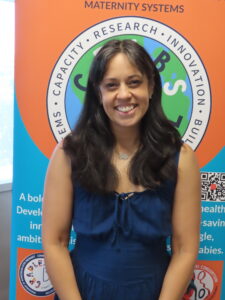
 Jenie Sparkes qualified as a midwife in 2001, aged just 25.
Looking back, she describes herself at the time as “very young, very naive”, but with an instant passion for clinical care that would shape the next two decades of her career.
This Is How Babies Are Born All the Time
That passion, fittingly, has a slightly unconventional origin story. Jenie trained through direct-entry midwifery, a route that let her become a midwife without first qualifying as a nurse, something she knew from the start wasn’t the path for her. Her very first birth as a student midwife was a home birth, and it left a lasting impression: “This is how babies are born all the time,” she remembers thinking. “I love this.”
After qualifying, Jenie worked at Luton, in a high-risk maternity setting, before having two home births of her own with her sons. These experiences that only deepened her belief that women deserve options in how they give birth. As midwifery began shifting more women into hospital settings, Jenie made the move to a low-risk midwifery unit at the Whittington Hospital in North London, where she supported water births for the first time. “Babies born how we were made to,” as she puts it.
From Labour Ward to Lab Coat
Determined to keep progressing, Jenie moved to Watford General Hospital to complete a Band 6/7 development programme, working towards her long-held goal of becoming a labour ward coordinator, partly spurred on, she admits, by someone once telling her she’d never make it. She proved them wrong. But balancing shift work with raising two young sons became increasingly difficult, and in 2013 Jenie made a significant career pivot: she took up a post as a research midwife at St Thomas’ Hospital.
Building a new skill set from scratch
It was a hard transition. Moving from the fast pace of labour ward coordination into research meant learning an entirely new skill set, from recruiting women into studies to the fine detail of data collection, largely from scratch. “It’s like midwifery,” Jenie says. “You just learn as you go.”
That grounding proved invaluable. Jenie went on to support some of the earliest work under what would become the CRIBS Global network, joining the very first PARROT trial alongside Professor Lucy Chappell, before moving through PARROT-2, GIANT PANDA, and now PAPAGAIO. Across each programme, she has built a reputation for something specific: an ability to read a study database and sense when something isn’t quite right. “I can read a story on the database and go, that’s something not right there,” she explains, “then go back to sites and gently ask questions until I understand why”. It’s a skill she credits with helping keep loss-to-follow-up rates low across multiple trials, simply by asking sites for whatever additional information they could gather, however small.
Working Quietly, Shaping Loudly
Ask Jenie what she enjoys most about her role, though, and she doesn’t point to the data; she points to the people. She lights up talking about the PhD students she’s supported over the years, watching them grow into the researchers they are today. “I’m not the loudest,” she says. “I don’t want the limelight. I just love sitting in the background, offering a gentle nudge, a different perspective, a question that helps someone see their own work in a new light”.
That supportive instinct runs both ways. Jenie speaks warmly about her working relationship with Professor Lucy Chappell, who, she says, recognised her strengths early: relationship-building, organisation, an instinct for data, and gave her the freedom to work in her own way, without micromanagement. “She found my strengths and utilised them,” Jenie says.
Choices, not just care
Alongside her research work, Jenie qualified in homoeopathy this year, a passion she’s now exploring in terms of how to bring it into women’s health, particularly around the menopause transition. Working alongside a pharmacist and personal trainer, she’s interested in how complementary approaches might support women through HRT, offer an alternative to it, or work alongside it. This runs alongside her guiding principle. “I want women to realise there are choices,” she says. “We’re so privileged in this country to be able to have this choice.”
With two sons now 20 and 17, and nearly a quarter of a century in midwifery behind her, Jenie ‘s story is a reminder of how varied a career in this field can be and how much of the research is built, quietly, by people like her working just out of the spotlight.